Saturday, January 15, 2011

cowboy, cowboy artist, cowboy poet,  cowboy art of ron jahns in sumpter oregon

Cowboy Poetry


written by......Ron Jahns


"The Marking Tree"


"This is a true story with the exception of one small detail
which I'm quite sure you'll notice......

There's a grizzly bear that roams up where the Kachatna River flows and
his height and weight, to this very date, the Good Lord only knows.

But he's awfully big, that fur-bearing pig, to that I can testify,
tho I've got to admit as here I sit, I've never looked him in the eye.

One September day found us way up the Kachatna for moose.
There was me, Dave and Roy, a local farm boy who was as comical as a 3 legged goose.

But the moose just weren't there, we looked everywhere but nary a one did we see,
but Big Dave and Roy, that joker farm boy, did find Ole Grizz's marking tree.

Now a bear's marking tree is a thing to see and a warning to all who come near,
for it says "Here am I, the woods meanest guy, and it's me you'd better fear".

But Dave wasn't impressed as he looked and guessed the claw marks to be some 12 ft. high,
but Roy says "He, He, this ain't no place for me. I'll see you in camp. Goodbye".

Now bodies are made so that sometimes we have to go when there ain't no bathroom around.
So Dave used Grizz's tree the same way a fire hydrant be used by them city dogs in town.

What an insult there lay on Ole Grizz that day when Dave used his tree for relief.
Now Ole Grizz was mad cause Dave acted bad and now there was gonna be grief.

Now the fight that ensued between them two dudes must have been a sight to behold.
And the winner who won when the fighting was done still ain't been told.

But Big Dave ain't quite the same and he walks kinda lame, tho still a fine lad he be
but the biggest mistake he ever made was when he peed on Ole Grizz's marking tree."

the end.....

Oregon's own Ghost Town
Sumpter

Sumpter, Oregon before the 1917 fire that destroyed most of the city, photo courtesy Oregon Geneology


In 1862, five men from South Carolina were on their way to the California gold fields. Along the way, Hugh Asbury, John Reel, Fletch Henderson, Bill Flanagan and Dick Johnson, camped near a place called Cracker Creek.

While they were there, they decided to do a little gold panning along the creek and were excited when bits of the precious yellow metal appeared in their pans. The next thing you know, they weren’t on their way to California anymore, deciding to settle right where they were. Soon they built a small primitive cabin between McCully and Cracker Creeks and named it Fort Sumpter after South Carolina Fort Sumter, of Civil War fame. Oops, they didn’t realize there wasn’t a "P” in the word "Sumter.” In any case, the name stuck, though somewhere along the line, the word "Fort” was dropped from the town’s name. Today, remnants of that first cabin can still be seen about a half mile above Sumpter on the Granite Road.

Growing slowly due to its remote location, the first post office was not established until 1874. It was hard to get to Sumpter in those days, as the wagon road that wound over the hills to Baker City was nearly 30 miles away. However, that very same wagon road became the early stage route that connected many of the mining towns of the area.

Around 1895, Sumpter began to grow as new technology made it easier to extract the gold. Just two years later the Sumpter Valley Railway extended its track to the settlement and the town grew to some 300 people. It was then, that the boom really began and miners began to arrive in numbers.

By the turn of the century, several brick buildings were built and streets were paved with planks. The new railway was delivering as much as six carloads of mining equipment daily and there were seven stage lines running. The town soon earned the nickname, The Queen City, as it became the hub for several surrounding mining camps.

By the turn of the century, almost nine million dollars in gold had been taken from the area's 35 mines. The town, which had grown phenomenally, sported seven hotels, sixteen saloons, three newspapers, two churches, an opera house, two banks, a red light district, and dozens of other businesses. A couple of years later when the census was tallied, it found over 3,500 registered voters which did not include women, children or Chinese immigrants.

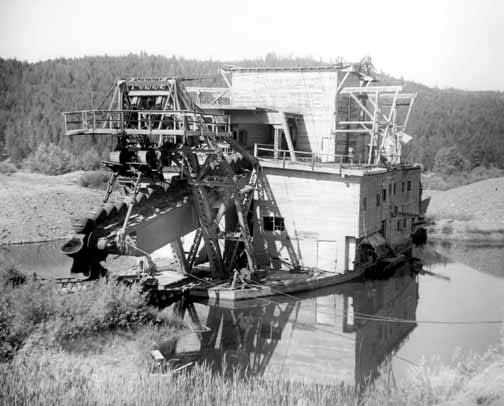
In 1913 dredging came to the Powder River. The remains of Dredge #1 can be seen near the Sumpter Valley Railway depot in McEwen. Dredge #2, the largest of three dredges used to extract the precious gold, can also be seen at the edge of town in a pond of its own making. Dredging continued in the valley until 1954.

On August 13, 1917, Sumpter was the site of a devastating fire. Starting in the Capital Hotel, the fire soon spread to adjacent buildings, and despite all efforts to contain the flames, nearly 100 buildings were completely destroyed. Lying totally in ruins, the fire spelled the death of the Queen City. Hard rock mining was winding down in the area and many miners simply moved on to more profitable strikes.

The Sumpter Valley Railway began its decline in 1933 and passenger service was discontinued around 1937. The last run was in April of 1947.

Today there is still gold in the bedrock of Sumpter Valley and continues to lay there as it was too deep for the dredges to get to it. The town has seen a revival as a historic tourist attraction, where the evidence of its former gold mining glory days is still in evidence in the many mine tailings.

Sumpter Gold Dredge

Sumpter Gold Dredge in 1959

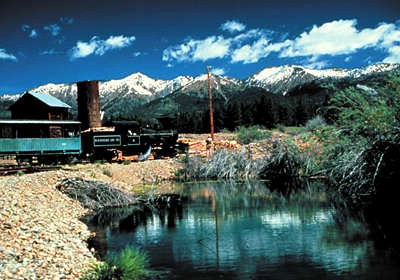
Sumpter Valley Railroad

Sumpter Valley Railroad, photo by Steve Terrill,

courtesy Oregon Tourism Commission

Dredge #2 has been preserved and now sits in the midst of Sumpter Dredge State Park, where tours of the old dredge are available during the summer. The town also provides a historic Narrow Gauge Railroad, where tourists can experience the early 1900s by taking a steam engine tour of the area.

On Memorial Day and Labor Day weekends, as well as on the 4th of July, the town comes alive with one of the most popular Flea Markets in the state. Be sure to plan on spending the day at the hundreds of vendors who set up throughout the town.

Sumpter is thirty miles west of Baker, Oregon on OregonState Highway 7.

Oregon Fun Facts & Trivia

In Oregon it is illegal to use canned corn as fish bait

Oregon and New Jersey are the only states without self-serve gas stations. According to Oregon state law, an attendant must pump your gas.

The Oregon Trail is the longest of the overland routes used in the westward expansion of the United States. The Trail used from 1840 to 1860 began in Missouri and ended inOregon. It was about 2,000 miles long.


It is against the law in Myrtle Creek to box with a kangaroo.


The hazelnut is Oregon's official state nut. Oregon is the only state that has an official state nut.


The Nike "swoosh" logo was designed by University of Oregon student Carolyn Davidson in 1964 -- four years after business undergrad Phil Knight and track coach Bill Bowerman founded the company they originally called Blue Ribbon Sports. Ms. Davidson was paid $35 dollars for her design


The Carousel Museum contains the world's largest and most comprehensive collection of carousel horses.


In Portland, people are banned from whistling underwater.


The Tillamook Rock Lighthouse, built in 1880, is currently used as the site of the final resting place of up to 467,000 cremated individuals.

Slow-Cooked Chicken Cacciatore

1 tbsp oil
3 pounds chicken
4 cloves garlic, minced
2 tbsp Italian seasoning
1 can (28 ounces) tomato puree
1 pound mushrooms
2 medium onions, chopped
1 medium green peppers
1 1/2 cups chicken broth
1/4 cup cornstarch
1 package (16 ounces) fettuccine, cooked and drained


Heat oil in pan over medium high heat. Add chicken and cook until all is browned.

Stir in garlic, Italian seasonings, tomatoes, mushroom, onion, pepper, and `1 cup broth into the slow cooker, add chicken.

Cover and cook for 7-8 hours on low, until chicken is cooked through. Remove chicken and keep warm.

Stir in cornstarch and remaining broth in a small bowl until mix is smooth. Stir the mix into the slow cooker. Cover and cook for 10 minutes on high or until mix boils and thickens. Serve with chicken and fettuccine.

Southwest White Chicken Chili

1 tbsp oil
4 skinless breast
t, cut into cubes
4 tsp chili powder
2 tsp ground cumin
1 large onion, chopped
1 medium green pepper, chopped
1 can (10 3/4 ounces) cream of chicken soup
3/4 cup water
1 1/2 cup corn
2 cans (15 ounces each) white kidney beans
2 tbsp shredded cheddar cheese

Heat oil in pan over medium heat. Add chicken, chili powder, onion and pepper and cook
until chicken is cooked through and vegetables are tender, stir occasionally.

Stir the soup, water, corn, and beans in a saucepan and heat to a boil. Reduce heat to low. Cover and cook for 5 mins, stir occasionally. Sprinkle with cheese.

Brown sugar brownies

1 cup packed light brown sugar
1/ cup butter, softened
2 eggs
2 ounces unsweetened chocolate, melted
1/2 flour
1 cup walnuts, chopped

Preheat oven to 325. Grease 8x8 pan. In large bowl, beat sugar and butter until fluffy. Beat in eggs, one at a time. Beat in chocolate, then flour, stir in nuts, pour in pan. Bake for 25. Let cool then cut into bars
Makes 2 dozen bars.

Savory Cheddar Muffins

2 cups flour
3 1/2 tsp baking powder
1 tsp salt
14 cup butter or shortening
1 egg, beaten
1 cup milk
1 cup grated cheddar cheese

in large bowl, combine flour, baking powder, and salt. Cut in butter until mix resembles fine crumb. stir in remaining ingredients just until moistened. spoon into well greased muffin pans. Bake at 425 for 25 minutes. makes 12

Ultimate Party Meatballs

1-14 ounce can cranberry sauce
1-12 ounce bottle Chili sauce
1- 2 pound bag frozen meatballs

Combine sauces in a large saucepan. Cook over medium-low heat, stir until smooth. Add meatballs. Cover and cook for 15 minute or until meatballs are heated through, stir occasionally.
Makes 30 appetizer servings.

www.ultimatepartymeatballs.com

WHAT TIME IS IT?